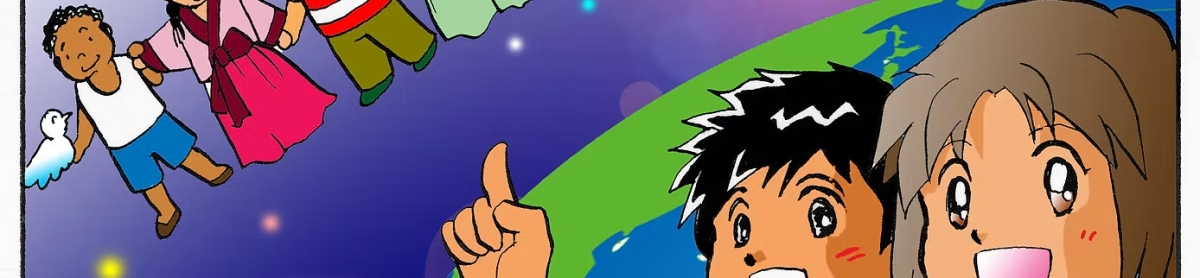
融合
NHK総合9月5日5:30「タモリ・山中伸弥!人類の進化、新たな謎」は20数種人類について新しい観点を提示している。人類の系統樹はむしろ何百万年に渡り共存・交雑・遺伝子・人類は吸収・融合し網目のようにしてきたと言うのである。
2010年ロシアで発見されたこれまで知られていない古代人類の骨を発見しパプアニューギニアの部族にデ二ソバ人にその遺伝子があることを発見したスバンテ・べーボ博士は2020年ノーベル賞受賞しその後台湾・チベットでも確認された。
それはデニソワ人と呼ばれその遺伝子はホモ・サピエンスに数%含まれていることが判った。ネアンデルタール人の遺伝子が数%含まれている事が知られて来たのでこれによって他人種は滅びたがホモ・サピエンスが生き残ったとされた説は覆された。
1980−90年代には多地域新仮説が主流であったが、1990年代DNA 研究によりアフリカ単一起源説に変わったが、デニソワ人との交雑により新しい見方が出て来た。約5万年前ネアンデルタールと交雑、4万5千年前デニソワ人と交雑と考えられた。
実は初期型ホモ・サピエンスがネアンデルタールと25万年前中東で交雑した事が遺伝子解析から知られ、生き延びたネアンデルタール人に保存されたその遺伝子が約6万年前ネアンデルタールと交雑した現ホモ・サピエンスに受け継がれた。
同様の事がデニソワ人とアジアの超古代人(現人類)とが交雑しており、その遺伝子がデニソワ人を通じて現在のホモ・サピエンスに受け継がれている事が判った。
ホモ・サピエンスの繁栄は知性によると考えられたが、様々な環境に適応する能力も大きい事が知られる。チベット高地や北極極寒地やパプア酷暑に生きる力、日本人の糖尿病予防、感染症予防の為にデニソワ人の遺伝子が貢献していると判った。
ネアンデルタール人の動脈硬化予防、紫外線適応・日焼け反応に有効な遺伝子を受け継いでいる。現代ホモ・サピエンスは生活習慣病を予防する力を古代人が獲得した能力として、その遺伝子を通じて受け取り享受している。
「古代にはホモ・サピエンスのネアンデルタールの遺伝子は10%位と思われるが、当時の人口数千人位と考えるとホモ・サピエンスの人口が多く10対1とすると闘争絶滅より交雑吸収と考えられる。」篠田謙一
「人類だけでなく生物の進化そのものを考え直さないといけない。」篠田謙一
「以前は例えばネアンデルタール人デニソワ人ホモ・サピエンス人と別れた系統樹で考えられていましたが、実は遺伝子の間に繋がりがありネットワークになっているのです。私たちは人種について考え直す時が来ました。」スバンテ・ペーボ
「以前はネアンデルタール人は争いによって滅びたと考えられていましたが、争いによってではありません。愛によって一つになったのです。」ラスムス・ニールセン
Fusion
The NHK General TV program broadcast at 5:30 on September 5, “Tamori and Shinya Yamanaka: Human Evolution—New Mysteries,” presented a new perspective on the more than twenty known kinds of ancient humans. It suggested that the human family tree was not really a branching tree. Rather, over millions of years, different human groups coexisted and interbred, their genes and populations being absorbed and fused into a network-like pattern.
In 2010, the bones of a previously unknown ancient human group were discovered in Russia. Dr. Svante Pääbo, who identified genetic traces of this group among peoples of Papua New Guinea, received the Nobel Prize in Physiology or Medicine in 2022. Evidence of the same genetic inheritance was subsequently confirmed in Taiwan and Tibet.
This ancient human group was named the Denisovans, and it was discovered that several percent of their DNA survives in Homo sapiens. It had already become known that modern humans also carry several percent Neanderthal DNA. These findings overturned the theory that all other human groups became extinct while Homo sapiens alone survived.
During the 1980s and 1990s, the multiregional hypothesis of human evolution was influential. DNA research in the 1990s then led to the predominance of the single African origin theory. Discoveries of interbreeding with Denisovans, however, brought forth a new understanding. It was thought that Homo sapiens interbred with Neanderthals about 50,000 years ago and with Denisovans about 45,000 years ago.
Genetic analysis has now revealed that early Homo sapiens interbred with Neanderthals in the Middle East about 250,000 years ago. The genes passed into those surviving Neanderthals were then inherited by modern Homo sapiens through renewed interbreeding with Neanderthals about 60,000 years ago.
Something similar occurred between Denisovans and extremely ancient human populations in Asia. Genes from those populations were preserved among the Denisovans and, through them, passed on to present-day Homo sapiens.
The success of Homo sapiens was once attributed primarily to intelligence, but the ability to adapt to widely differing environments is now also recognized as crucial. Denisovan genes have been found to contribute to human survival on the Tibetan Plateau, in the extreme cold of the Arctic, and in the intense heat of Papua New Guinea, as well as to resistance to diabetes and infectious diseases among Japanese people.
We have also inherited Neanderthal genes that may help protect against arteriosclerosis and contribute to adaptation to ultraviolet radiation and tanning responses. Present-day Homo sapiens have received and continue to benefit from abilities acquired by ancient humans—including capacities that help prevent modern lifestyle-related diseases—through the genes they passed down to us.
“In ancient times, the proportion of Neanderthal genes in Homo sapiens may have been around ten percent. If the population numbered only several thousand and Homo sapiens outnumbered Neanderthals by roughly ten to one, this suggests interbreeding and absorption rather than extinction through conflict.”
—Ken’ichi Shinoda
“We must reconsider not only human evolution, but the evolution of living beings itself.”
—Ken’ichi Shinoda
“Previously, we imagined a branching family tree in which Neanderthals, Denisovans, and Homo sapiens separated from one another. In reality, however, their genes are interconnected, forming a network. The time has come for us to reconsider how we think about race.”
—Svante Pääbo
“Neanderthals were once thought to have become extinct through conflict. But it was not through conflict. They became one through love.”
—Rasmus Nielsen
“Humanity survived through coexistence and interbreeding. Neanderthals and Denisovans no longer exist as separate populations, but they live within us. If we disappear, humanity disappears.”
—Ken’ichi Shinoda
“Our ancestors accepted both Neanderthals and Denisovans. Ancient human groups differed from one another far more than any populations existing today, yet they coexisted. Viewed from this evolutionary perspective, the conflicts of the modern world appear rather strange.”
—Svante Pääbo
。
.
.

.
.
.
.
 平和・平安:非戦・非核 Peace/Safety: No War/No Nuke