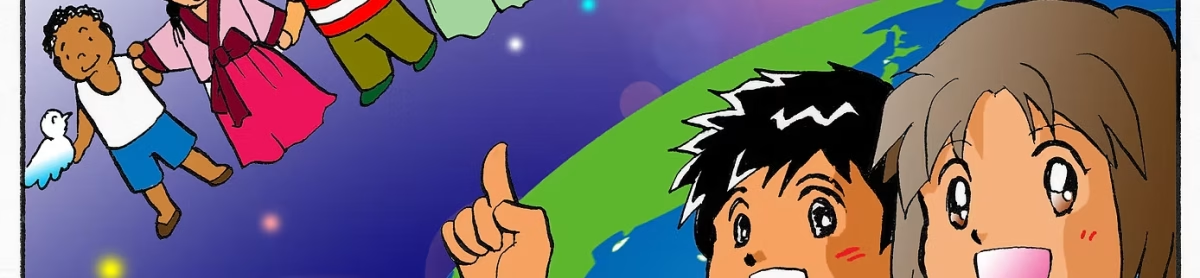
地球化
お早うございます!
現代は政治・経済・社会・文化が交通・通信の発達により地球規模に広まり交流する時代である。しかし政治は最も遅れ唯一地球化が遅れており地球問題群を生み独裁・戦争・核・破局の人間業三毒の苦悩・文明の私有化・袋小路を生んでいる。
約5・6千年前に始まった都市国家は文字、法律、交易、科学、哲学、芸術、民主政を発展させたが、余剰生産物を上部へ集め支配層と被支配層が都市内外民・環境支配破壊の金字塔構造を作り、階級、奴隷、軍隊、都市間戦争を制度化した。
近代主権国家は15~17世紀の西欧で形成され1648年のウェストファリア講和により象徴され、国民国家は、1776年の米革命と1789年の仏革命によって人民・国民を主権者として成立し19世紀西欧から世界大戦のの後世界へ広がった。
国民国家は王朝・帝国支配を打破して市民の自由・平等を進めたが、同時に国境、徴兵、戦争、植民地化を強化する金字塔構造になり気候変動・パンデミック・種大量絶滅・環境汚染・独裁・核・戦争等国家主義を越えないと解決不可能である。
普遍法縁起は吾我も我国も孤立自存主宰主権の絶対的存在ではないから人類・生類・生態系へ枠を広げ責任を取り軸時代の五・十戒に基づく地球倫理を守り、金字塔文明の覇権競争から命帝釈網文化の共同世界へ枠組転換する事が必須急務である。
現在国連構成員は193カ国に聖座、パレスチナ、台湾、コソボの197国があるが、人口最大148億人のインド、最小1万人弱のツバル、面積最大1,600万km²のロシア最小2km²のモナコ、民族・文化・言語など千差万別であるが単一民族はない。
コーサラ王波斯匿王は自分程愛しいものはないと言うと茉莉花妃も合意しブッダに尋ねると、「その通り。だが他者も同じだから大切にせよ。」と教えられた。各人が共同・法世界に目覚めて活動する事が民主主義の根本、政治地球化の意味である。
Globalization
Good morning!
The modern age is one in which politics, economics, society, and culture have expanded to the global scale and increasingly interact through the development of transportation and communication. Politics, however, the only major sphere whose globalization has been delayed, came into dead-end by privatization. It consequently generates global problematique producing the sufferings of dictatorship, war, nuclear annihilation, and catastrophe, rooted in human karma and the triple poisons, thus creating a crisis of civilization.
City-states, which began to emerge about five or six thousand years ago, developed writing, law, commerce, science, philosophy, art, and democracy. Yet they also created pyramidal structures that concentrated surplus production at the top. Ruling and ruled classes were formed, while people and environments both within and beyond the city walls were dominated and destroyed. Class hierarchy, slavery, armies, and warfare among cities became institutionalized.
Modern sovereign states took shape in Western Europe from the fifteenth through the seventeenth centuries, symbolized by the Peace of Westphalia in 1648. Nation-states emerged through the American Revolution of 1776 and the French Revolution of 1789, which established the people—the nation or natives (from √nat: to be born)—as sovereign. From nineteenth-century Western Europe, the nation-state system spread throughout the world, especially after the World Wars.
Nation-states overthrew dynastic and imperial domination and advanced the freedom and equality of citizens. At the same time, however, they became pyramidal structures that reinforced borders, conscription, warfare, and colonization. Problems such as climate change, pandemics, mass extinction of species, environmental pollution, dictatorship, nuclear weapons, and war cannot be solved unless we transcend nationalism.
The Universal Dharma of dependent co-origination teaches that neither the “myself” nor “my state” exists as an isolated, self-sufficient, self-governing, absolutely sovereign entity. It is therefore essential and urgent that we expand our framework to embrace humanity, all living beings, and the entire ecosystem; assume responsibility for them; observe a Global Ethic grounded in the Five and Ten Precepts articulated during the Axial Age; and transform our framework from the hegemonic competition of pyramidal civilization into the shared world of a life Indra-net culture.
There are presently 193 United Nations member states. Adding the Holy See, Palestine, Taiwan, and Kosovo gives a broader count of 197 states. Among UN members, India has the largest population, approximately 1.48 billion, while Tuvalu has the smallest, at fewer than ten thousand. Russia has the largest land area, approximately sixteen million square kilometers, while Monaco has the smallest, at about two square kilometers. Their peoples, cultures, languages, and other characteristics differ enormously, yet no state consists of a single homogeneous people.
King Pasenadi of Kosala said that no one was dearer to him than himself, and Queen Mallikā agreed. When they asked the Buddha, he taught:
“That is true. But others feel the same way; therefore, cherish them as well.”
For each person to awaken to the shared world and the Dharma-world, and to act accordingly, is the foundation of democracy—and the true meaning of the globalization of politics.
Thank you.

.
.
.
 平和・平安:非戦・非核 Peace/Safety: No War/No Nuke